Self-Regulated Teaching Intelligence
An instructor-facing research prototype that turns ordinary class recordings into inspectable, evidence-linked feedback for post-class reflection.
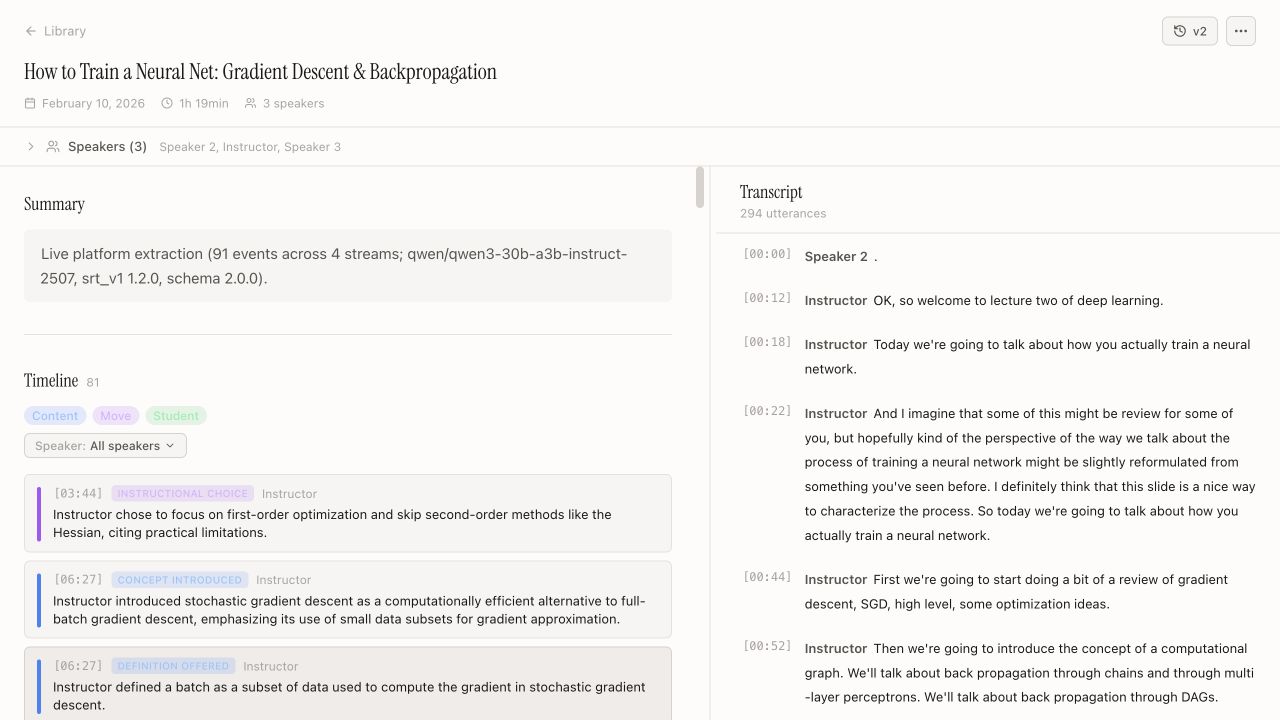
The problem
Instructors get little timely, structured evidence about their own classrooms: end-of-semester evaluations arrive too late, peer observations are rare, and memory is a weak basis for judging talk balance, wait time, questioning, or participation.
The approach
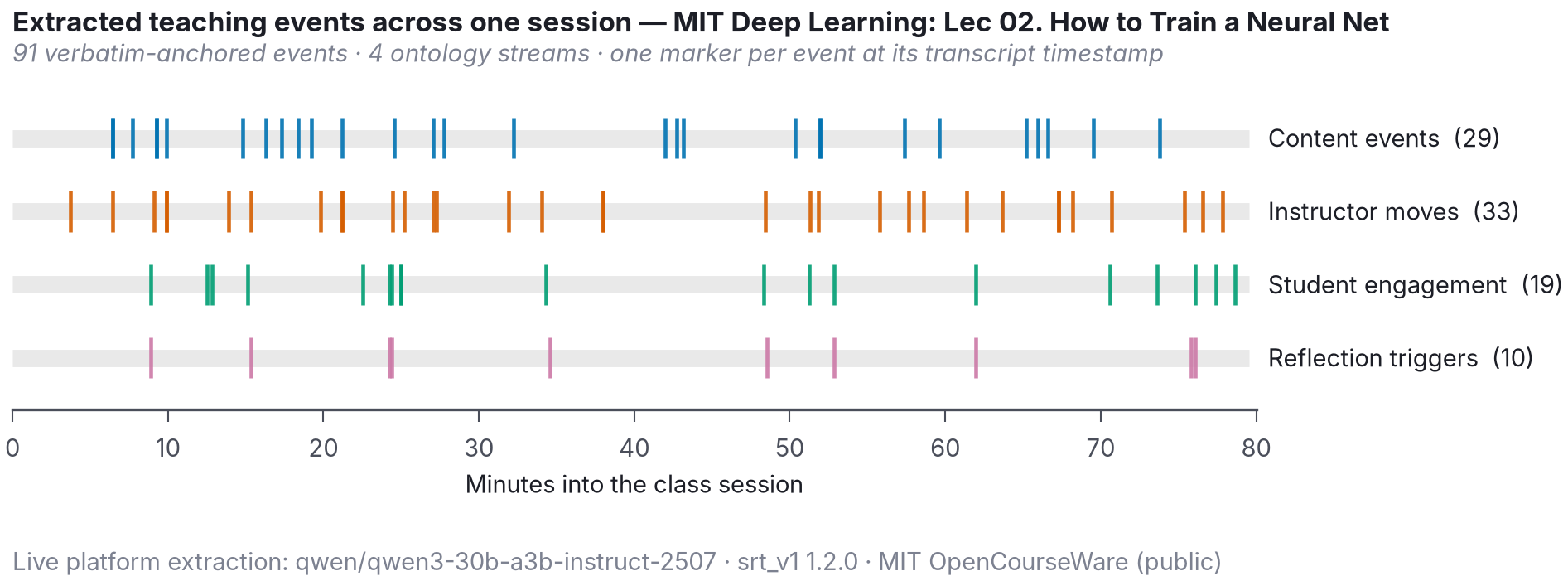
Class audio becomes a speaker-attributed transcript and four streams of pedagogical events (content, instructor moves, student engagement, and reflection triggers), alongside deterministic measures like talk ratio, wait time, and question rate. The pipeline is deterministic-first: the language model proposes events, deterministic code decides, and every event is verbatim-anchored so an instructor can jump from any claim to the passage behind it.
Research basis
Self-regulated teaching is the instructional counterpart to self-regulated learning: instructors need evidence to set goals, monitor their practice, and adapt. SRTI turns that construct into a working instrument, and its pilot (20 open-courseware lectures, human-ratified reference labels, per-stream accuracy results) is the lab studying its own tool before trusting it.
What it does today
- Ingests class audio, transcribes it locally, and separates speaker turns with editable attribution.
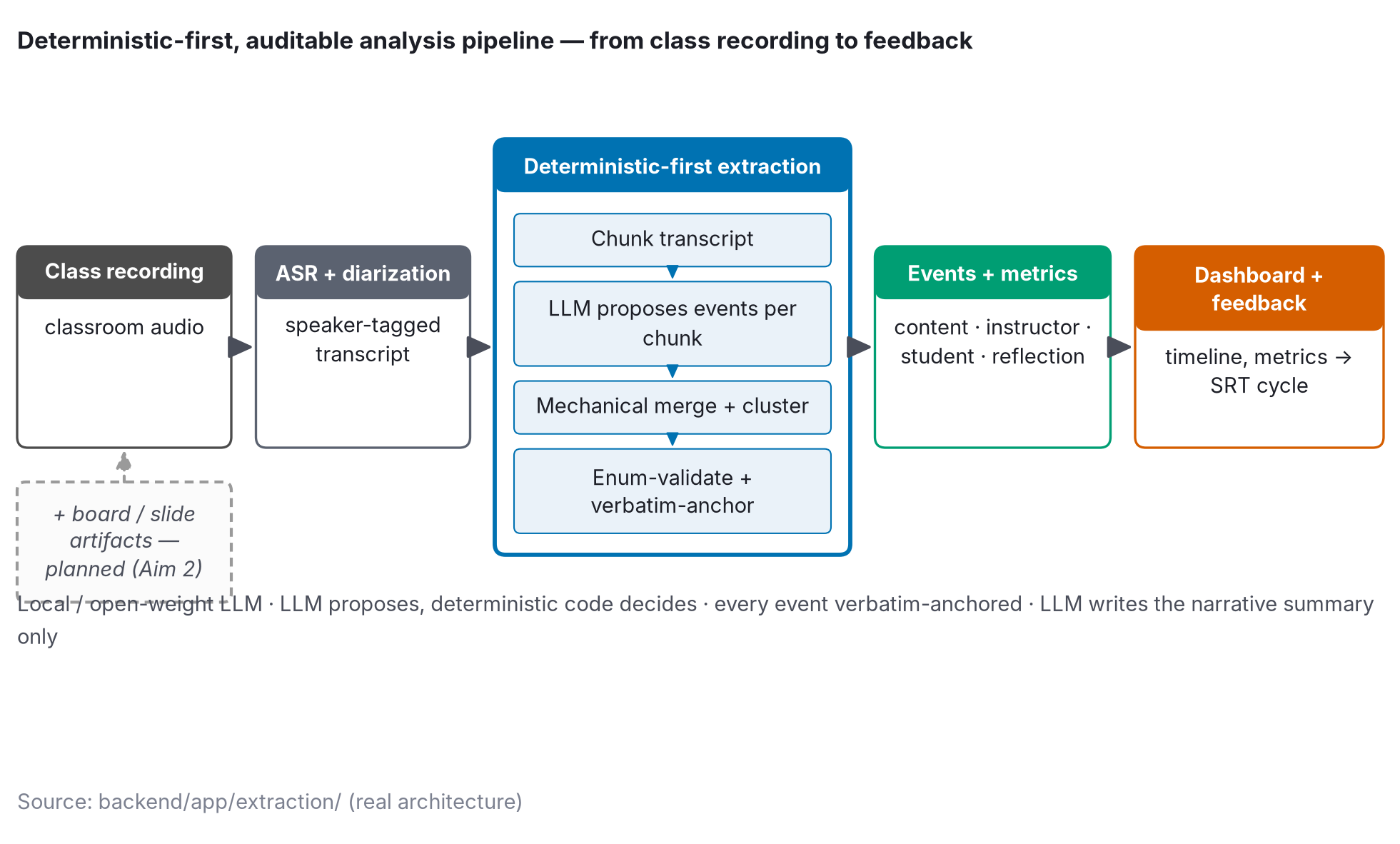
- Organizes transcript-grounded observations into four streams: content events, instructor moves, student engagement, and reflection triggers.
- Computes deterministic measures: instructor/student talk ratio, wait time, turn counts, longest monologue, question rate and type.
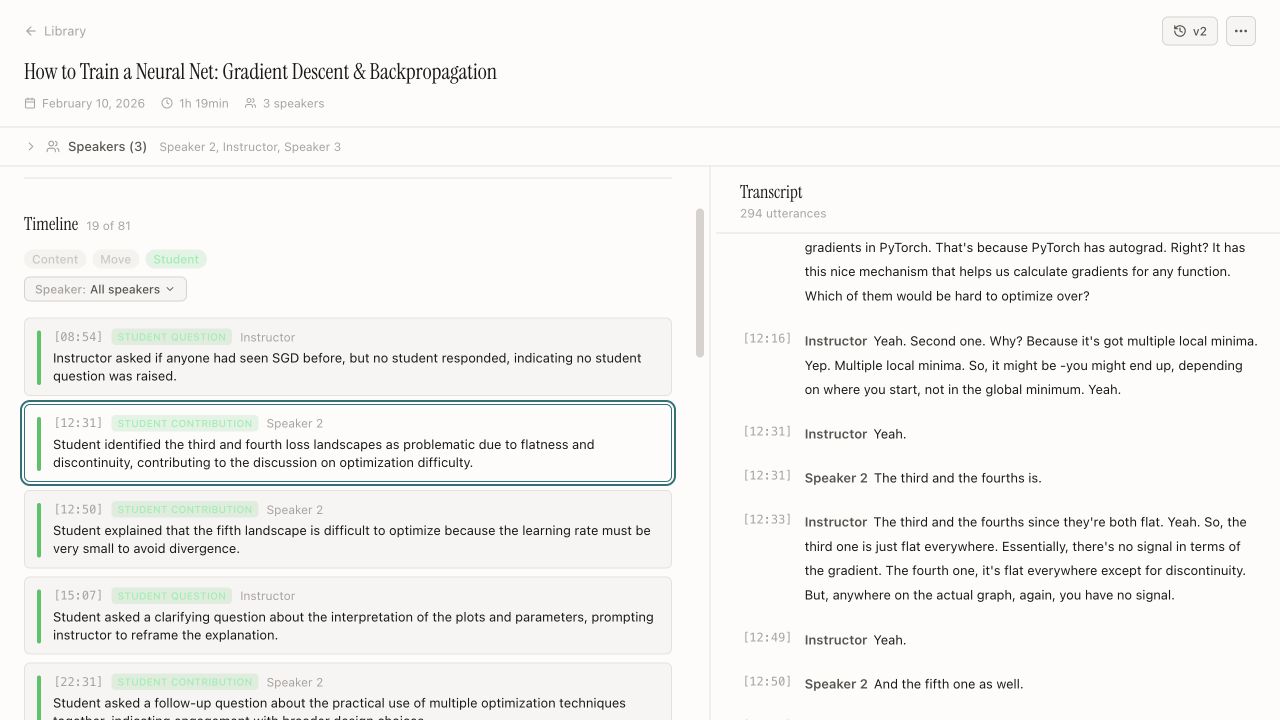
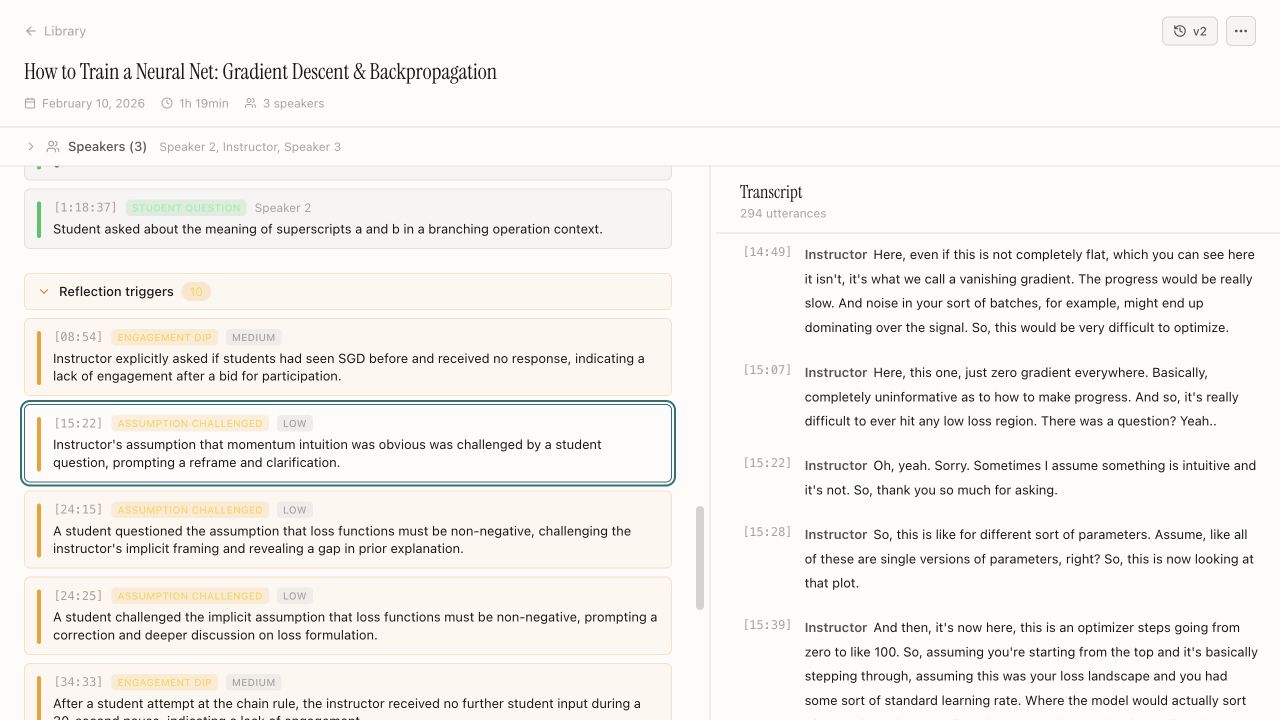
- Lets an instructor filter the session timeline by stream or speaker and jump from any claim to its supporting passage.
- Keeps analysis version history, with model and schema metadata on every run.
- Ships a reproducible evaluation harness with a 20-lecture human-ratified reference corpus.
What it does not do
- No hosted product, self-service onboarding, or production support; this is a private, internally deployed prototype.
- Not validated in live classrooms; the pilot corpus is public courseware, which underrepresents student interaction.
- Audio-only: it cannot observe body language, movement, visual materials, written work, or silent engagement.
Inside the prototype
Evidence
Working pipeline on real lecture audio
The screenshots are live pipeline output over an 80-minute public MIT OpenCourseWare lecture, with 91 verbatim-anchored events across four streams. They are not seeded fixture data.
As of 2026-08-28
Measured, including the failures
A 20-lecture pilot across five disciplines: 1,346 candidate events, 1,112 retained after human ratification, 100% verbatim-anchor resolution, and per-stream accuracy reported honestly from F1 0.68 down to 0.22.
As of 2026-07
Engineering depth
1,363 automated tests documented in a dated internal evidence memo, alongside a reproducible evaluation harness.
As of 2026-07-06
What we are not claiming
- The pilot shows feasibility, not that the system accurately evaluates teaching. Concrete student-engagement events were strongest (detection F1 ≈ 0.68, 0.86 type agreement on matched events); instructor moves reached only ≈ 0.33 and reflection triggers 0.22 after rubric revision. The weak streams are named on purpose.
- The pilot is small and bounded: 20 lectures, one run each, no confidence intervals, and reference labels that were LLM-assisted then human-ratified rather than an independent expert-coded gold standard.
- It is a professional-development and research tool. It is not designed, and should not be used, for employee evaluation or student surveillance.
Responsible use, privacy, and rights
- Real classroom audio, transcripts, student identities, speaker maps, and instructor analytics are never published, and live-classroom use requires consent, IRB, and privacy review.
- Interface imagery uses public MIT OpenCourseWare material with attribution; no private classroom data appears.
Where it came from
- CAREER: Minds and Machines: Exploring Engineering Faculty Member Mental Models of Generative AI and Instructional Decisions
National Science Foundation CAREER Award · 2024-2028
- EAGER: Natural Language Processing for Teaching and Research in Engineering Education (NLPTREE)
National Science Foundation EAGER · 2022-2025
More from the Studio
All entriesUse it
Course Sphynx
A faculty-facing platform for helping instructors redesign courses through guided, transformation-oriented support.
Explore it
GATOS qualitative analysis workflow
A research workflow for using open-source generative AI and machine learning to support inductive qualitative codebook development.
Explore it
CATS QDA
A local-first workspace where qualitative researchers analyze sensitive interview data with AI assistance they can inspect, override, and audit.